Moving to Spain…again, 17 years later

This story begins in the mid 1990’s when, as a fresh faced 21-year-old university graduate, I embarked on a gap year in Europe.

The initial summer months were spent swanning about Italy and France with exchange student friends at their family holiday houses, followed by backpacking across Greece and Turkey.

When the cold weather finally caught up with me in Istanbul and winter was closing in, I decided it was time to settle somewhere and re-engage my higher brain. I settled in Salamanca, Spain – one of the oldest university towns in Europe – where I enrolled into a Spanish language course and made fast friends with my Dutch, German and Italian housemates.

It was an exhilarating experience to be playing house in a foreign city while exploring a new language, culture and customs. We were having the time of our lives learning about Spain as well as our 21-year-old selves; and the friendships made during this ‘coming of age’ experience were destined to last.

Image

My Dutch housemate and me in Salamanca

Image

House mates after my 22nd birthday party

At a certain point though, great experiences must come to their inevitable conclusion, and I had to return to Australia, to my other life that required me to become a responsible adult.

Fast-forward 8 years to 2004

I was sitting in the cinema in Sydney with my spunky, new husband and my large belly housing our first child. We were watching a French film called The Spanish Apartment (L’Auberge espagnole), about a French university graduate who goes to Spain for a year to study and lives in an apartment with a group of zany students from around the world.

The antics of this young and eclectic group brought tears of laughter to my eyes that swiftly developed into heaving sobs of despair for a former life that I had lived and would never know again.

Image

The Spanish Apartment movie

Whether it was pregnancy hormones or the process of adjustment to married life with imminent child, the film triggered a grief in me that my life was about to change irrevocably.

Fast-forward another 9 years to 2013

It is unequivocal that my life has changed since I first visited Spain as a 21-year-old and since I saw The Spanish Apartment:

I am now a wife of 10 years and a mother of an 8-year-old boy and 6-year-old girl. Those early parenting years were quite tough at times and there are still today the occasional blindsides but overall life has settled into a happy equilibrium.

Image

Family life in Australia

Being an explorer at heart, it is time to embark on a new adventure: another gap year in Europe, this time with my nearest and dearest in tow.

And so, we as a family have decided to move to Spain for a year. First we will travel for two months retracing our family history and friendships across four countries, before settling down in Granada, Andalusia for 11 months.

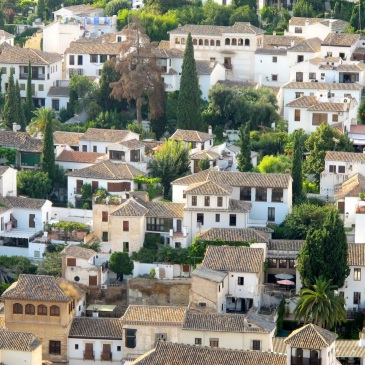
We have found an old Moorish house to rent in the Arabic quarter with cobbled stone pedestrian streets and no cars.  Instead of looking at the Tasman Sea each day our outlook will be the magnificent Alhambra Palace and Sierra Nevada mountains.

Image

A new view – The Alhambra Palace and Sierra Nevada Mountains

The kids will go to a local Spanish school and my husband and I will combine study, part-time work and general mooching about.

I am under no illusions that this experience will compare at all to the free-spirited Spanish adventure of my 21-year-old self or that it will be smooth sailing all the time – no travel experience ever is.  I am however, excited to be sharing an adventure with the ones I love and to see new things through their eyes.

The four of us will share this trip as a family unit that will hopefully bring us closer and bode us well for the bumpy adolescent years around the corner.

100 days of firsts and lasts

We’ve hit the 100-day (3 months) mark in the countdown to our big year abroad.

Suddenly this crazy idea is becoming a reality and is beginning to alter our thoughts and actions.

Chris Stewart sums up the feeling beautifully in his book “Driving Over Lemons” which is a story about packing up and moving to a farm in Andalusia, Spain: “…we were…numbed with surprise to find ourselves actually taking part in a script we ourselves had written.”

That is precisely what is taking place for us now as we face the mountain of tasks involved in packing up our life – so much administration to deal with alongside the excitement of cutting loose for an entire year.

We have talked about this idea for years, waxing lyrical to our friends about our plans, yet now that we are on the home stretch, we are numbed by the surreal idea that it is actually about to happen.

Image

Where do we go?

Events that we have participated in annually are now articulated as “the last one until 2014”. Our last “Picnic Under the Stars” at school, our last swim of the season for a few seasons to come, our last Passover Seder with friends, our last birthday parties among many other lasts.

We have been on a “buy nothing new unless it is coming in the suitcase” regime since Christmas. This has been liberating and challenging to implement while living in a highly consumerist society. It has been particularly challenging for the children however they are beginning to understand that what we will experience is more valuable than the latest plastic toy or game.

Image

Our life will be packed into a few suitcases and storage

Just this week at the supermarket I have had to shift from my usual bulk purchasing of washing powder, soap, shampoo and water filters, to buying just enough to get us by until we leave. I am starting to change my habits in small ways that will undoubtedly lead to bigger habitual shifts in the coming months.

So they are the lasts. What are the firsts?

The “firsts” are documented in long month-by-month list of “to do” items that must be completed by 23rd June. It is an overwhelming list of mostly administrative (me) and physical (my husband) tasks that rouse soporific exhaustion (is that a tautology?) just to look at.

Just some of the tasks to be completed before we will be cut free from our daily grind for a year are:

  • working out what to do with all our stuff,
  • finding someone to rent out our place,
  • getting our head around various insurance policies we require for health, Spanish residency and travel,
  • Enrolling the children into Australian distance education as well as their Spanish school
  • Packing up the house
  • Rehousing the dog

AND THEN FINALLY…

  • GETTING ON THE PLANE AND COLLAPSING FROM EXHAUSTION!!!

It’s all very administrative at the moment but we understand that doing this work now will allow us to focus on our life in Europe when we finally get there.

Image

Brother and sister on a departure lounge trolley

The overwhelming kindness of others

I recently had a conversation with some friends visiting from the United States. One of their overwhelming experiences from travelling in Australia was the genuine and trusting nature of Australians who, they observed: “were interested to help in any way and also to know us as individuals. There is an openness and trust that is noticeably different and refreshing,” they commented.

Well, I can now attest to the fact that this is not unique to Australia. As we prepare for our year in Spain and Europe (only 4 months to go!!!), I have been overwhelmed by the generosity and kindness people everywhere have shown us – many of whom we have never met and yet their care from afar is extraordinary.

Leunig shows us how kindness is done

Leunig shows us how kindness is done

I have always believed that people are inherently well meaning and that the small percentage of people who do harm to others are not “bad people” but have been injured themselves in some way.  This is a belief I am hoping to impart on my children, as I do not want them to live a life fearing “others”.  That is why I allow my children to walk the four blocks to school alone. Granted, we are lucky to live in a country like Australia where there are few real dangers (other than those from nature or climate change but that’s another blog post!!). Ultimately I believe that living without fear allows generosity of spirit to be fostered.

Kindness inspires kindness - too true

Kindness inspires kindness – too true

While we are away I hope we will have the opportunity to give back as generously as those who have shown us incredible kindness so we can continue the good kharma.

Here is a summary of some the generosity people have shown us already:

  • Our future landlords in the Albayzin, Granada have connected us to other families in the area to help us enroll our children into the local school, find a violin teacher and a tennis centre for our children etc…
  • One of the lovely parents at the school our children will attend has been liaising with the school principal on our behalf and has offered to complete the paperwork for us to enroll our children before we arrive
  • A family in Burgundy, France who we do not know but who are friends of my French colleague here in Sydney, has invited us to stay with them and proudly show us their beautiful town and countryside.
  • My wonderful Swiss school friends whom I have not seen since my exchange year 22 years ago are hosting a “welcome back” party in our honour and another has offered us her apartment in Geneva for the duration of our stay.
  • My husband’s family friend in Helsinki, Finland who is like a godmother to him has given us her apartment in Helsinki as she will be staying at her summer cottage. This is despite not having seen each other since our wedding 10 years ago
  • Another beautiful French friend has offered us her holiday house in the South of France to celebrate our 10-year wedding anniversary.
  • Other expat families who are already living in Spain and have read my blog, have offered us help and advice
  • My parents’ friends in Hungary have bombarded us with offers of places to stay and things they want to show us

And the list goes on…

Such pride and joy people have in their homes and countries that they generously seek to share with others. If this is not incentive enough to take a risk and travel overseas or to  welcome others to your home or country, I don’t know what is!

The world according to airbnb…

Firstly, I have to say that this is not an ad for airbnb although I am an enormous fan of this relatively recent phenomenon in travel.

airbnb is an online platform that allows people to rent out their homes or rooms to visitors from other parts of their country or the world. For those planning travel, it is an opportunity to live like the ‘locals’ by renting a local person’s apartment, home or room.

I am a curious traveller who likes to experience a taste the “the local life”.  Even before discovering airbnb, I mostly avoided hotels on my travels except where necessary as I find them sterile, manufactured experiences where your only private space is a 25m square box.

Now, I have become so enamoured of this online service while planning our upcoming year living and travelling in Europe that I fear I may be developing voyeuristic tendencies. Browsing airbnb from my couch in Sydney, I have peered into the homes of hundreds of ‘locals’ in Paris, Geneva, Helsinki and Granada, Spain. In the process I have observed some interesting differences from country to country:

The Finns, for example, appear to prioritise kitchens above all other rooms in the home. Most of the places I looked at in Helsinki were tiny yet had large, stylish, modern kitchens dominating the home. Finns also seem to take great pride in the style and decoration of their homes, mostly preferring the clean white Scandinavian look. I asked my husband who previously lived in Finland, why kitchens are such a big deal. He said that, as it is very expensive to eat out in restaurants, people entertain a lot at home.

White on white in Finland

White on white in Finland

Parisians, from my airbnb perusals, do not seem to worry too much about bathrooms and kitchens which are often just little holes in the wall, however lounge areas are usually well laid out and cozy.  French interior design is more on the shabby chic side of things compared to the clean lines of Finland.

The Spanish (please remember these are generalisations, not quantitative research) appear to have a particular home decor style of dark timber with white lace tablecloths and curtains. Their coffee tables in front of lounges are often the height of a dining table, which leads me to wonder if Spaniards have a lot of TV dinners on the couch?

Unless I have conversed with people who live in the town or city I am visiting, I feel as though I have not visited the place. I want to know how people live, how they spend their time and what they think etc… I want to participate in the life of a particular destination.

My husband on the other hand, an introvert by nature, loves to observe from the periphery. On one of our first trips together to Mexico, we experienced this stark difference in our travelling styles. My husband is a native Spanish speaker and I relied on him to translate or converse with people for me. I desperately wanted to talk to people and ask them questions but I was dependent on my husband who was less interested in initiating conversations.

Now with the help of Airbnb, I already have my first foot in the door towards experiencing a snapshot of local life by living in a local’s place and having them provide information about their favourite activities and places to go. Thank you airbnb!!

By the way, this is the apartment we have booked in Paris via aribnb. It’s a mix of Finnish style in the heart of Paris and is owned/managed by a lovely Mexican man.

Our Parisian airbnb apartment in le Marais

Our Parisian airbnb apartment in le Marais

kitchen large rooftops1 sunset rooftops

The Paralysis of Choice

Decisions, decisions, decisions…

Once you decide to pull up your roots and remove yourself from all the things that are known to you, the options and choices are suddenly numerous. When you are no longer tethered to the obligations and joys of history and community, the choices are wide open.

And so, as we begin to pack up our long-term life in Australia and plan for a year overseas, we are faced with a dizzying array of choices and decisions to be made – all of them good I might add.

  • Where will we live?
  • Which places will we travel to?
  • Which family and friends will we visit and for how long?
  • By what mode of transport and what order will we do it all in?

Occasionally I suffer a paralysis of choice, losing myself in a myriad of Google maps, information and other people’s stories.

Currently at home in my daily life, I bumble along because so many decisions that influence today, were made years ago – like where we live, who our friends are, where we work. Other than daily functioning, there aren’t that many new decisions to be made each day.

We obediently follow the rhythm of work, invitations to family gatherings, friends’ birthday parties, weddings, funerals, anniversaries etc… We love this life and the sense of belonging, however in many ways, we have also become servants to it.

By packing up and doing something different, we have become more alert and are proactively engaged in choosing how we will spend our time and resources during our year away. Where we tend to become stuck is in narrowing down the choices of places we want to visit as there are just so many.

As Australians who live far from the rest of the world, once we arrive in Europe, determining which places to visit is a challenge. Ultimately we have decided to prioritise family and friends over specific interests in places for their art, history, architecture or food. This has been a difficult choice as I have dreamed of visiting cities like Copenhagen, Berlin and Prague. The greater pull, however, is towards reconnecting with family and friends in Finland, France, Hungary and Switzerland.

We acknowledge that a large part of this trip is about reconnection to our European heritage, for our children and us. And if there is spare time and resources during our year, our other interests will hopefully be explored.

The only city we have committed to visit as “tourists” is Paris as our son has made a very persuasive argument for his “need” to visit this city. He has been learning French since pre-school and has developed a keen interest in all things French.

Here is our wish-list of places to visit that extend beyond reconnecting with family and friends:

1)   My Francophile husband and son are keen to spend time in the South of France to fulfil a long-held fantasy

Provence, France

Provence, France

2)   I have always admired and wanted to visit Denmark for its progressive social and environmental policies as well as its cutting edge design. Some things I admire about Denmark are: its commitment to renewable energy, the high rate of urban communal housing, Danes are apparently the happiest people in the Western world, the recent introduction of a “fat tax” on food containing high fat, their beautiful design aesthetic and the list goes on… not to mention visiting the home of LEGO for the kids.

Beautiful, fascinating Denmark

3)   My eight year old ‘car loving’ son, has discovered that there is a Ferrari museum in Italy and is determined to go there.

4)   And the art…El Prado Museum in Madrid, the Hermitage Museum in St Petersburg, the Uffizzi in Florence, Le Louvre in Paris…. oh, but to dream!

The Hermitage Museum, St Petersburg

The Hermitage Museum, St Petersburg

Finally, as Sarah Wilson says: “There is never a perfect decision. The best option transpires only because a decision of some sort was made that served as a stable base from which to build and create an end result.”

Granada – Nos vemos pronto!

Granada here we come… soon!

Image

It has been decided… we are going to live in Granada, Andalucía for one year. Despite never having set foot in this city, Granada has consistently come out on top of the “preferred places to live in Spain” list when tested against our criteria:

  • A small/ medium city with a significant local Spanish population i.e. not dominated by expats.
  • A mild climate (important for soft Australians unaccustomed to European winters)
  • Castellano as the official language – not Catalan, Basque or other dialects or regional languages.
  • Accessible to other places for weekend explorations
  • A significant or noteworthy attraction in the city
  • A university and good schools

What Granada offers:

  • It has approx. 350,000 – 450,000 inhabitants and has all the amenities of a city without the hassles of a metropolis.
  • It has nature all around it that is easily accessible as it is located at the foothills of the Sierra Nevada Mountains, half an hour from the ski fields and one hour drive to the coast and beaches.
  • It has a prestigious university, a good hospital, several schools and sites of historical significance – the Alhambra Palace and the Generalife Gardens to name the most noteworthy.
  • It has an elaborate Moorish, Roman and Jewish history with traditional flamenco dancing and tapas specialities still prevalent today.
  • It is home to mostly Spanish inhabitants (less than 5% of the population are expats) unlike many towns and cities on the Mediterranean Coast which are home to large populations of expats from northern Europe.
  • It has a mild climate given its location in southern Spain lying at a latitude of 37.1742°North and at an elevation of 738 metres. It’s a bit colder than Sydney but not bone chilling.
  • It is one of the cheapest places to live in Spain. I have found some beautiful apartments to rent for AU$250 a week

So far when I have met Spaniards here in Australia and told them about our plans to live in Granada for a year, I have been met with resounding support for our choice of city.

Most friends who have visited Granada also agree it is a good place for us. This is exactly what I need to hear considering I have never been to Granada and we are choosing it purely from a theoretical decision making process (not my preferred process).

The only hesitation so far has been from my friend from Barcelona who was concerned about the strange, clipped Spanish accent in the south as well as the “provincial” culture compared to the more “progressive” culture in Barcelona and Madrid.

When I mentioned that we were looking for an experience that was very different from our lives in Sydney, she seemed to understand that Granada would be less like a Spanish version of our Australian life.

Image

Some other interesting facts about Granada:

  • Granada means pomegranate
  • Granada is located at the foot of the Sierra Nevada Mountains, at the confluence of three rivers, the Beiro, the Darro and the Genil.
  • Many Caliphs, Arabic sultans and dynasties originally ruled Granada.
  • Granada was one of the last strongholds when Christian groups joined together to drive the Muslims and Jews out of Spain in 1492. Muslims and Jews were forced to either leave Spain or convert to Christianity.
  • Federico Garcia Lorca was from Granada and was one of the most celebrated Spanish playwrights and authors. He was shot by firing squad near Granada during bloody Spanish civil war in 1936-39.

Image

Something strange is happening to me

I have become obsessed with Europe and we still have 9 whole months to wait until our departure…

Yes, it’s true, I am a planner and researcher and I have become obsessed with planning our year in Spain that is still 9 months away. It has led to great frustration in our household because I have completely lapsed in my domestic responsibilities in favour of being permanently glued to my computer/ ipad/ iphone, madly researching, enquiring and reconnecting with family and friends in Europe.

Another major pitfall is that I should be focusing on working more and saving for our trip but alas, part of me has already left for Europe or at least, is desperate to be there already.

One peculiar side effect of this obsession is that I have started to enter every competition I can find where the prize is a trip to Europe. I have signed up to websites I have no interest in, given my personal details and email address to everyone and anyone who dangles the carrot in front of me: “WIN A TRIP TO EUROPE”.

Perhaps I can go on a sneaky reconnaissance mission to Europe before we actually move there next year – research is very important!! Or maybe if we win a trip, it will cover our airfares next year. Honestly I think the answer lies in the psychology of immersion into anything involving Europe and the hope associated with “winning” so entering competitions is what I do now. My sister has a not so flattering term for what I am doing but conveniently I have already forgotten what it is.

Anyway, the latest competition I am entering takes it to a new level. Nomadic Matt is running a competition where I have to make a video blog entry telling him why I want to go to Budapest, Prague and Vienna. It made me think about the family tree I recently began that traces my parents’ heritage in Hungary. It began as a project for my Dad’s 70th birthday last month and has now stalled until we can find someone to conduct the remaining research in Hungary.

The family tree project also prompted me to ponder what my parents’ childhood was like and why they had to escape Budapest as teenagers to start a whole new life at the bottom of the Earth in Australia. It got me excited about showing my children where their beloved grandparents come from, not to mention all the fried langos with garlic and sour cream, turos palacinta and goulash we could eat while there!